Frequently Asked Questions
A municipal utility district (“MUD”) is a political subdivision of the State of Texas authorized by the Texas Commission on Environmental Quality (“TCEQ”) to provide water, sewage, drainage, roads, parks and recreational facilities, and other utility-related services within the boundaries of the MUD. When a plan is created to develop an area of land which does not fall within a City’s boundary, a MUD can be created to allow for the payment of costs related to planning, excavation and installation of water lines, sewer lines (both sanitary and storm), drainage facilities, roads, park and recreational facilities, utility services, etc. The debt is paid for by the residents who choose to live within the MUD and use the public facilities.
A MUD may be created through the TCEQ or through an Act passed by the Texas Legislature. Williamson County Municipal Utility District No. 23 (the “District”) was created by an Order of the TCEQ dated January 25, 2008, and operates pursuant to the terms and provisions of Article III, Section 52 and Article XVI, Section 59 of the Constitution of Texas and Chapters 49 and 54 of the Texas Water Code, as amended. The District’s Director elections are held in May of even-numbered years and are administered by the Williamson County Elections Administrator.
Regardless of which agency approves the creation of a MUD, five temporary Directors (“Directors”) are appointed to a MUD’s Board of Directors (the “Board”), who served as temporary Directors until an election is called to confirm the creation of the MUD and elect permanent Directors. Directors serve staggered four-year terms.
- The Board manages and controls all of the affairs of a MUD, subject to the rules and regulations stipulated by the Texas Legislature with on-going supervision of the TCEQ.
- The Board establishes policies which are in the interest of its residents, while abiding by the above-listed rules and regulations.
- A MUD may adopt and enforce all necessary charges, fees, and taxes necessary to provide district facilities and services.
Developers must petition the TCEQ or have a bill filed with the Texas Legislature to create a MUD. Developers are prohibited from serving or placing employees, business associates, or family members on the Board.
The laws relating to voting differ for an HOA and a MUD. In a MUD, only registered voters living within the boundary of that MUD may vote in an election. Thus, developers cannot vote in a MUD election and have no authority or control over a MUD Board of Directors.
Because a MUD generally has no funds available prior to development and the cities are unwilling or unable to extend utilities to land outside their boundaries, the Board of the MUD enters into a reimbursement agreement with the developer that requires the developer to finance 100% of the costs of all public utilities and infrastructure within the MUD. Then, once there are enough homes or other improvements constructed by the developer and there is sufficient taxable value in the MUD, the MUD’s financial advisor will recommend that the MUD issue bonds to reimburse the developer for the costs of the public infrastructure and/or facilities.
Before the bonds are issued and sold: (1) the TCEQ will review and approve a bond application submitted by the MUD in order to confirm that the issuance of such bonds is “feasible” in accordance with the TCEQ rules; (2) the Attorney General of the State of Texas must review and approve the transcript of proceedings in connection with the bond issue and issue an opinion that the bonds are valid and legal obligations of the MUD; and (3) an independent third-party auditor must issue a report verifying that the developer is due the reimbursement requested.
The District is a completely separate entity from the HOA. The District has no affiliation with the HOA, no authority over the HOA, and no ability to intervene in HOA matters.
The District is a political subdivision of the State of Texas (like a city or county). The District’s Board of Directors are public officials of the State of Texas (similar to a city council member) and are elected by the registered voters who reside within the boundaries of the District.
The HOA is a corporation formed by the developer to set and enforce rules and regulations for the subdivision. The HOA board is also elected, but the HOA board is elected by the property owners within the subdivision and HOA votes are usually weighted by the number of properties owned (i.e., one vote per home or lot owned).
The HOA encompasses only the Morningstar subdivision, whereas the District encompasses the Morningstar subdivision plus the apartments and commercial properties along Kaufman Loop.
The District levies an ad valorem tax that is based on the taxable value of all property in the District, including both residential and commercial.
The HOA levies a uniform assessment to all properties within the HOA.
Williamson County Appraisal District determines the appraised value of all property within the District. The current tax rate levied by the District is $0.95 per $100 of taxable assessed valuation — $0.53 per $100 assessed valuation to make annual payments on the utility debt, $0.295 per $100 assessed valuation to make annual payments on the road debt, and $0.125 per $100 assessed valuation to pay for the District’s ongoing maintenance and operation. As the debt decreases, the District’s taxes may also decrease over time. However, for as long as it is in existence, the District will need to levy an operations and maintenance tax rate.
The District is working to provide residents with a clear understanding of what the District maintains and what remains the responsibility of the Morningstar HOA.
Property ownership and maintenance responsibility are not always the same thing. Certain property within Morningstar is titled in the name of the District, while responsibility for maintaining specific amenities, landscaping, facilities, and improvements remains with the Morningstar HOA, pursuant to the Morningstar CCRs recorded in the Williamson County Real Property Records.
The District maintains District infrastructure and other areas for which the District has responsibility, including:
- All public roadways within the boundaries of the District (with the exception of Kaufman Loop, once such road is accepted by Williamson County for maintenance)
- Street signs
- Public sidewalks that are not adjacent to a residential lot or home (sidewalks adjacent to a home are the responsibility of the homeowner).
- Stormwater detention and drainage ponds
- Drainage and erosion-control infrastructure
- Streetlights and related equipment
- Fishing pond and associated infrastructure
- Other infrastructure and property for which maintenance has been assigned to or assumed by the District.
At the request of the HOA, the District agreed to maintain certain recreational and common areas, including:
- Dog park
- Disc golf / frisbee golf area
- Walking trails
- Landscaping along Kaufman Loop
The following areas, facilities, and services are the responsibility of the Morningstar HOA:
- Lawn and landscape maintenance along Morningstar Boulevard
- Lawn and landscape maintenance along Omega Ranch Road
- Lawn and landscape maintenance of most common areas
- Irrigation systems and irrigation water
- Pipeline/common-area corridor between Stone Canyon and Cross Creek Road
- All three swimming pools
- All three amenity centers
- Basketball court
- Zip line
- Pavilion area
- Landscaping at community road entrances
- Entrance monuments and surrounding landscaping
- Dog-waste stations
- Soccer field
- Improvements and amenities located inside gated areas
Just because the District owns certain property does not mean that the District is required to maintain that property. The HOA is a corporation and is required to pay ad valorem property taxes on all property it owns. The District is a governmental entity and does not pay property taxes on property it owns. The Morningstar CCRs (filed of record in 2017) state that the HOA shall own, operate, and maintain all pools, amenity centers, parks, and common areas. In an effort to save money for the HOA (and therefore the residents), the District agreed to accept ownership of the pools, certain amenities, and common areas, subject to a Maintenance Agreement that was signed by both the District president and the HOA president, which Agreement states that the HOA shall maintain, at its sole cost and expense, the pools, amenity centers, and common areas.
The Stormwater Management System of the District consists of 21 detention ponds, 2 retention ponds, filtration systems, controlled valves, drainage channels, and overflow structures located throughout the District.
The purpose of the District’s stormwater system is not to eliminate stormwater. Its purpose is to temporarily store, filter, and control the release of stormwater so that large amounts of runoff do not move downstream all at once. Together, the District’s detention ponds, retention ponds, filtration systems, controlled valves, drainage channels, and overflow structures help manage stormwater throughout the District and reduce the potential for downstream flooding and erosion.
The District’s detention ponds are designed to temporarily store stormwater during and after rainfall events. This helps control how quickly large amounts of water move through the District and into downstream drainage systems.
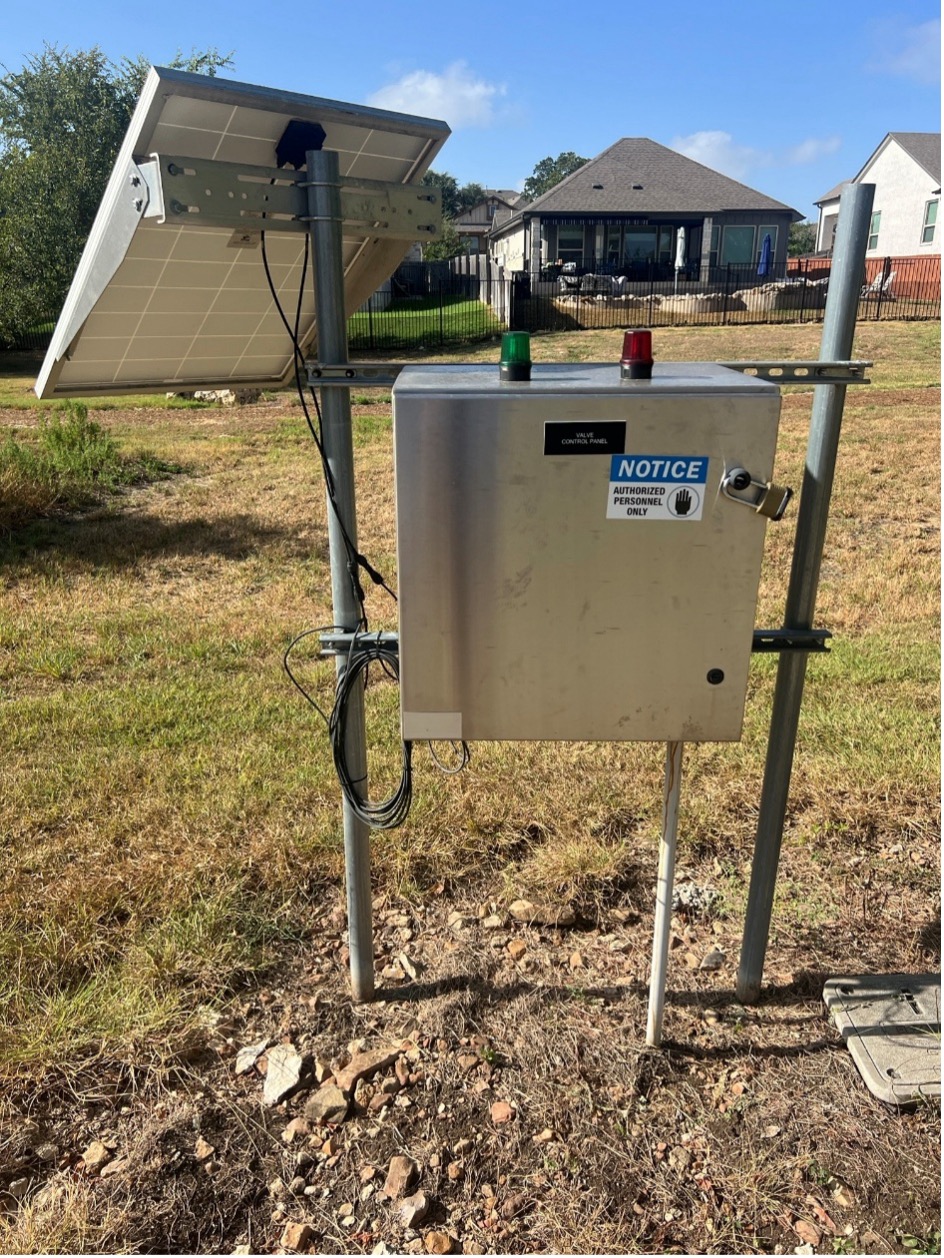
Some of the District’s detention ponds are equipped with solar-powered control systems that operate drainage valves. These systems allow stormwater to be held in the pond for a specified period and then released at a controlled rate.
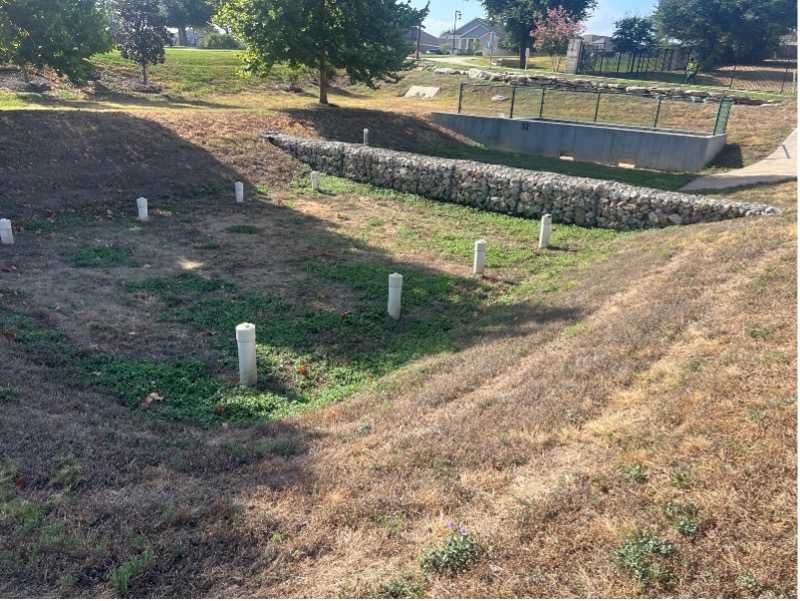
Other detention ponds within the District use sand-filtration systems. These ponds can be identified by their sand filtration areas and the white collection pipes extending above the surface.
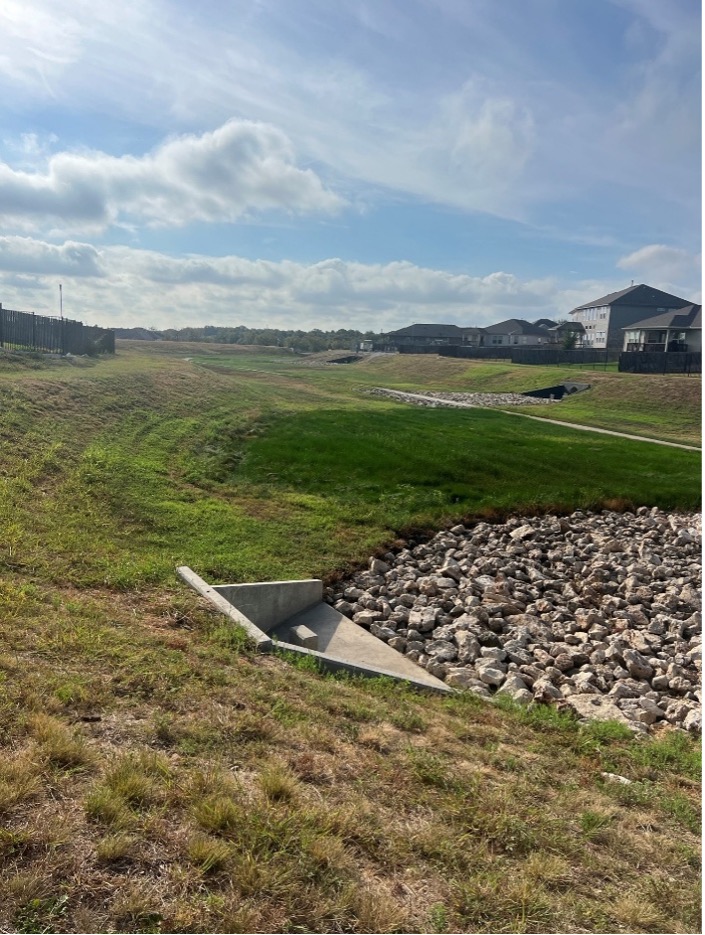
During major rainfall events, detention ponds can receive water faster than their normal drainage systems can release it. The ponds are therefore designed with overflow spillways that allow excess stormwater to safely pass through during unusually heavy rainfall. These spillways are an important part of the pond design and help protect the integrity of the pond and its embankments.
The District’s stormwater system also receives runoff from areas outside the District. As additional property surrounding the District has been developed (and continues to be developed), the amount of stormwater entering and passing through our drainage system has increased (and will continue to increase). How quickly the District’s ponds drain is also affected by downstream conditions. Stormwater leaving the District must travel through drainage systems and developments east of the District before eventually reaching the Middle Fork of the San Gabriel River. When downstream areas are already carrying large amounts of stormwater, water can back up and slow the drainage of the District’s ponds.
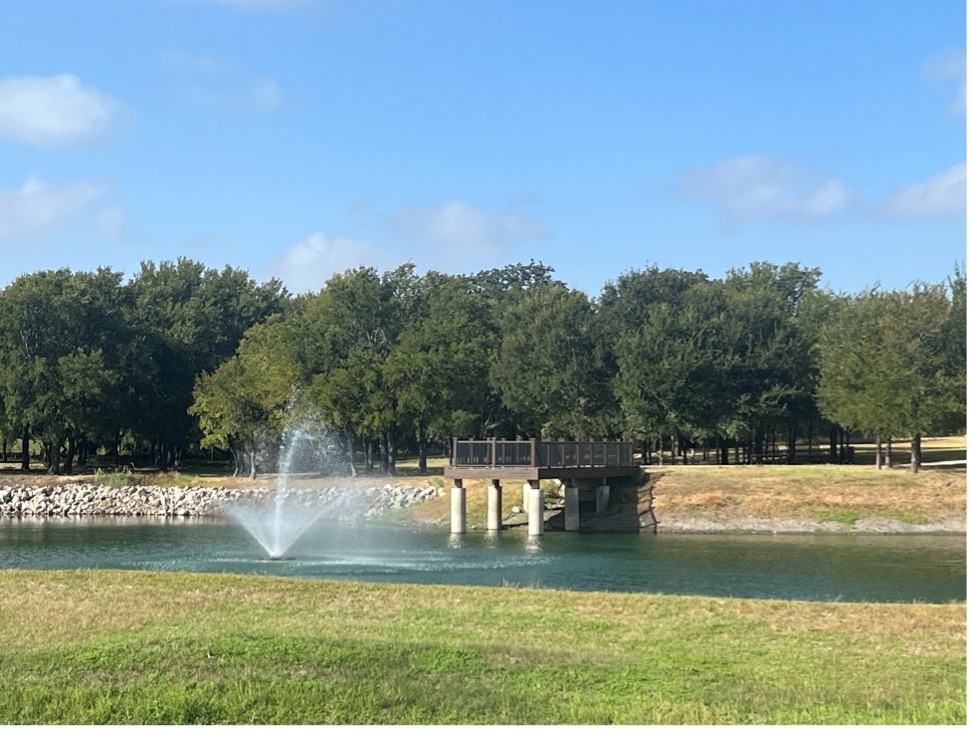
The District also has two retention ponds, which differ from detention ponds because they normally maintain a permanent pool of water. One of these is the District’s fishing pond, which includes a fountain and provides both stormwater storage and a recreational amenity for residents.
The developer constructed some of the District’s amenities, including the nature trails and the dog park, in the flood plain. Because they are located in the flood plain, the trails and dog park may be unusable following large rain events. After each such event, the District works diligently to make repairs as quickly as possible.